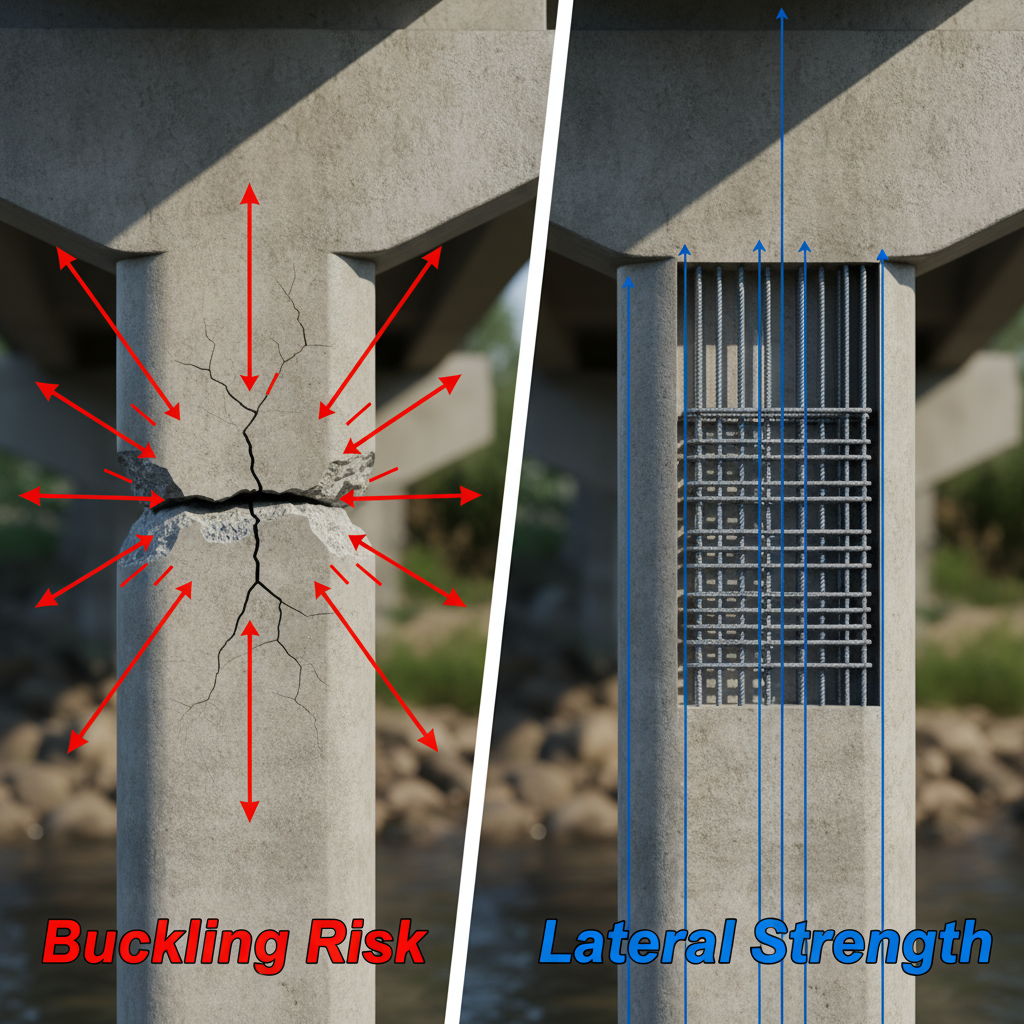
Abutment Pier Design: Preventing Buckling and Lateral Failure
In our previous discussions, we focused on the size of the concrete footing (the pad) required to resist the downward force (Reaction Load). However, the vertical part of the abutment—the pier or wall—must also resist forces that are often ignored in DIY construction: **lateral loads** and **buckling**.
1. Understanding Buckling and Slenderness
Buckling is the sudden, catastrophic failure of a compression member (like a concrete pier) when its height makes it unstable. It doesn’t crush; it bows out sideways. The primary measure of this risk is the **Slenderness Ratio**.
The Slenderness Ratio is the effective unsupported height of the pier divided by its smallest cross-sectional dimension (thickness).
Slenderness Ratio Calculator
Determine the stability risk of your proposed abutment pier design:
Calculated Slenderness Ratio: 4.0 : 1
This ratio is acceptable for typical reinforcement. Always consult an engineer for final approval.
2. Resisting Lateral Loads
Vertical piers must withstand forces pushing the bridge sideways, which can cause them to overturn or shear off their footing:
- Wind Load: Pressure exerted on the railing and deck surface.
- Stream Current/Scour: Force applied by moving water, potentially exacerbated by debris build-up.
- Seismic/Impact Load: Sudden shifts or objects hitting the structure.
To resist these forces, the pier must be anchored deep into the footing.
3. The Role of Rebar (Steel Reinforcement)
Concrete is incredibly strong under **compression** (pushing down), but weak under **tension** (pulling apart) and **shear** (sliding/tearing). Lateral loads and buckling create tension forces within the pier.
- **Vertical Rebar:** Needed to tie the pier securely into the footing pad and prevent the pier from failing under tension created during buckling or lateral pushing.
- **Horizontal Ties/Hoops:** Circular or square rebar ties needed to prevent the vertical rebar from bowing out and to confine the concrete core, which dramatically increases its compressive strength.
**Volume Concrete Recommendation:** For a durable, high-strength abutment, always use a minimum of four vertical #4 or #5 reinforcing bars tied into the footing and extending the full height of the pier.
Continue Your Bridge Education
Review the primary design calculator or learn more about the material below the ground.
Go to the Load & Foundation Demonstrator Learn about Soil Bearing Capacity (SBC)Frequently Asked Questions (FAQ) on Pier Stability
Q1: What is the main difference between footing failure and pier buckling?
A: Footing Failure occurs when the load exceeds the soil’s strength, causing the entire foundation to sink vertically. Pier Buckling occurs when the vertical concrete post itself fails sideways due to being too tall and too thin. Buckling happens even if the soil is perfectly capable of holding the load. It is a failure of the column geometry, not the ground beneath it.
Q2: How can wind or water cause the pier to fail?
A: Wind against the bridge railing and decking, or fast-moving water and debris hitting the pier (lateral forces), creates a bending moment at the base of the pier where it meets the footing. This moment introduces a significant tension force on the side of the pier opposite the pressure. Since unreinforced concrete is weak in tension, it will crack and eventually shear or pull apart at that joint, leading to catastrophic failure.
Q3: Why is rebar placement more critical in the pier than in the main footing pad?
A: The main footing pad’s primary job is resisting compression (vertical weight), which concrete excels at. The pier’s job is to resist tension and bending caused by lateral loads and buckling. Rebar provides the necessary tensile strength to keep the concrete from cracking and pulling apart under these forces. If you only use rebar in one place, it should be in the vertical pier and across the joint where the pier meets the footing.
Q4: If my pier has a high Slenderness Ratio, can I just add more rebar instead of making it thicker?
A: While rebar significantly increases a pier’s load-carrying capacity and resistance to buckling, it cannot completely compensate for excessive slenderness. The primary defense against buckling is increasing the pier’s cross-sectional thickness (making it wider or deeper). If the calculated Slenderness Ratio is above 12:1, professional engineering consultation is mandatory, as simply adding more rebar may not be sufficient to overcome the geometric instability.
Q5: Should the wooden beam rest directly on the concrete pier?
A: It should not. Direct contact between the wood and concrete should be minimized for two reasons:
- Moisture: Concrete wicks moisture, which can lead to premature rotting of the timber beam end.
- Movement: Temperature and moisture cause the wood to expand and contract.
Ideally, the beam should sit on a bearing plate (often steel or high-density plastic) and be secured with anchor bolts that are cast directly into the concrete pier. This connection must be engineered to prevent the beam from sliding laterally off the abutment.