The Thurston-Weeks Mechanism
Harnessing Chaos in a Simple Machine to Generate True Randomness
What is the Thurston-Weeks Mechanism?
The Thurston-Weeks mechanism, also called the triple linkage, is a deceptively simple mechanical system consisting of three rigid rods connected by hinges, with their outer ends fixed to pivots. Introduced in the 1980s by renowned mathematicians William P. Thurston and Jeffrey R. Weeks, it serves as a profound example of how basic geometry can produce extraordinarily complex and chaotic motion.
When constructed with precise rod-length ratios and allowed to move without friction, the linkage exhibits Anosov flow—a mathematically proven form of uniform hyperbolicity. This means that even minuscule differences in initial conditions amplify exponentially, leading to genuinely unpredictable behavior over time.

William P. Thurston
(1946–2012)
Fields Medalist, pioneer in low-dimensional topology

Jeffrey R. Weeks
Mathematician and cosmologist, known for work in hyperbolic geometry
Visualizing the Mechanism



A Mechanical True Random Number Generator
In 2022, researchers demonstrated that this linkage could form the basis for the world’s first mathematically proven purely mechanical true random number generator (TRNG). By sampling the position or angle of the linkage during its chaotic motion, high-quality random bits can be extracted—passing rigorous NIST statistical tests—without any electronic or quantum components.
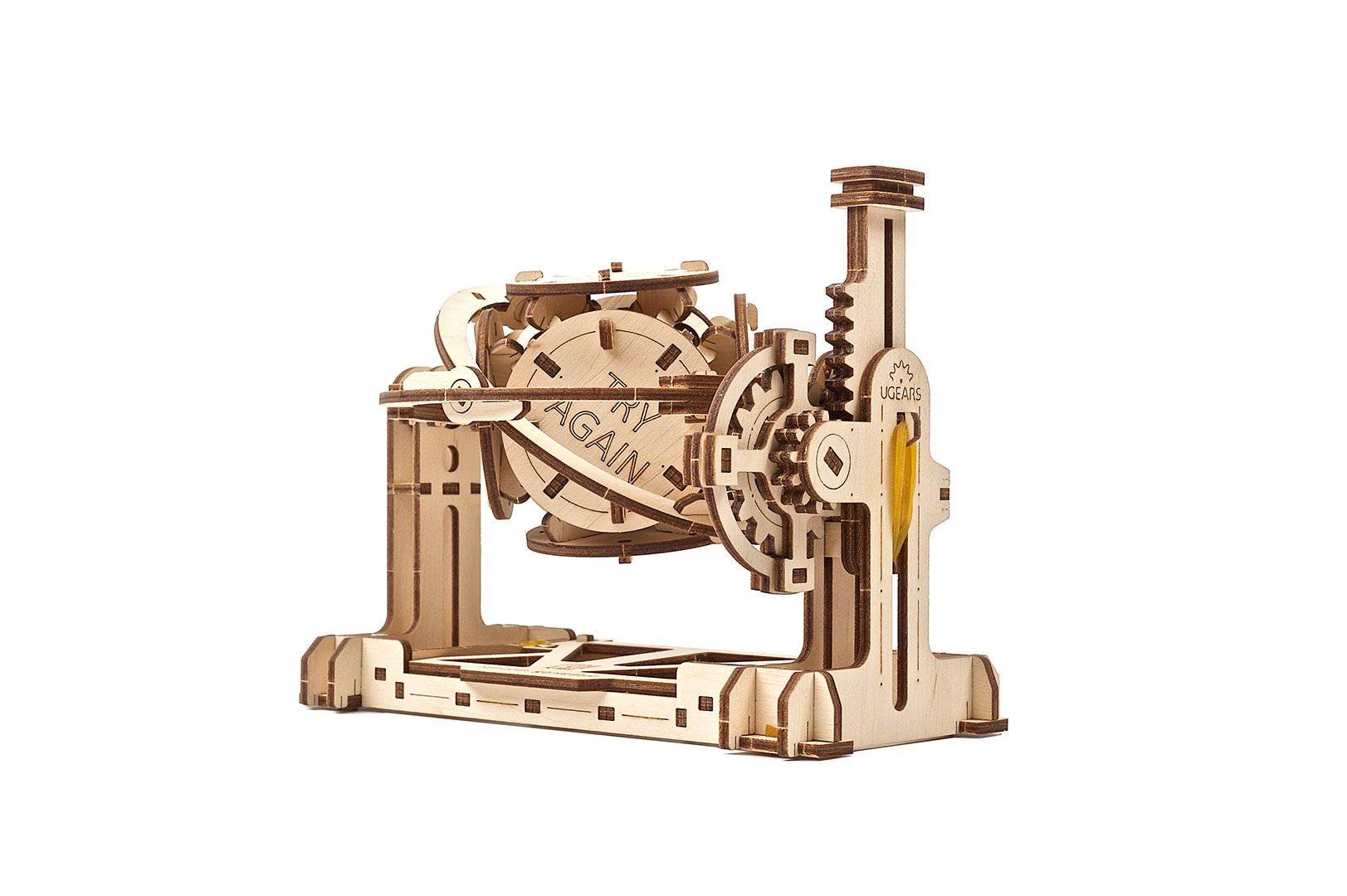
While practical mechanical TRNGs (like the UGears STEM Lab model below) are great educational tools, the Thurston-Weeks design elevates the concept to provable cryptographic-grade randomness through pure classical chaos.

Video Narration Transcript
Imagine a simple mechanical device made of just three rigid rods connected by hinges, with their ends fixed to pivots—like a triangular chain that can twist and fold in complex ways. This is the Thurston-Weeks mechanism, also known as the triple linkage, first described in the 1980s by mathematicians William Thurston and Jeffrey Weeks.
At first glance, it looks unremarkable. But when set in motion without friction and with specific rod length ratios, something extraordinary happens: the system enters a state of uniform chaos. Tiny differences in starting position or speed explode exponentially over time, making future behavior completely unpredictable. Mathematically, this is called an Anosov flow—a rare, provably hyperbolic chaotic dynamic proven in 2003 by researchers Hunt and MacKay.
In 2022, scientists proposed using this mechanism as the world’s first mathematically proven purely mechanical true random number generator. By sampling the linkage’s positions during its chaotic motion, you extract genuinely random bits that pass rigorous statistical tests—no electronics or quantum effects needed.
This elegant blend of geometry, chaos theory, and engineering shows how a humble set of rods can produce true unpredictability, bridging abstract math with real-world applications like secure cryptography.
Why Does This Matter Today?
In an era dominated by electronic and quantum random number generators, the Thurston-Weeks mechanism stands out for its purely mechanical elegance. It reminds us that true randomness doesn’t always require high-tech components—it can emerge from carefully designed classical systems governed by the laws of chaos theory.
Potential real-world implications include:
- Cryptographic security in low-tech environments – Imagine secure randomness in remote or resource-limited settings without relying on electricity or semiconductors.
- Transparent public lotteries and audits – A visible, tamper-resistant mechanical device could restore public trust in random drawings.
- Educational and philosophical insight – It beautifully illustrates how order (simple geometry) can give rise to profound unpredictability, bridging mathematics, physics, and engineering.
- Inspiration for new designs – Researchers continue to explore hyperbolic mechanisms for robust, noise-tolerant randomness sources.
While practical cryptographic TRNGs today rely on faster electronic or quantum entropy sources, the Thurston-Weeks mechanism proves a profound point: true unpredictability can be engineered with nothing more than rods, hinges, and precise mathematics.


At Volume Concrete, we’re fascinated by ideas that connect abstract mathematics to tangible mechanics. The Thurston-Weeks mechanism is a perfect example of how deep theory can inspire wonder in the physical world.