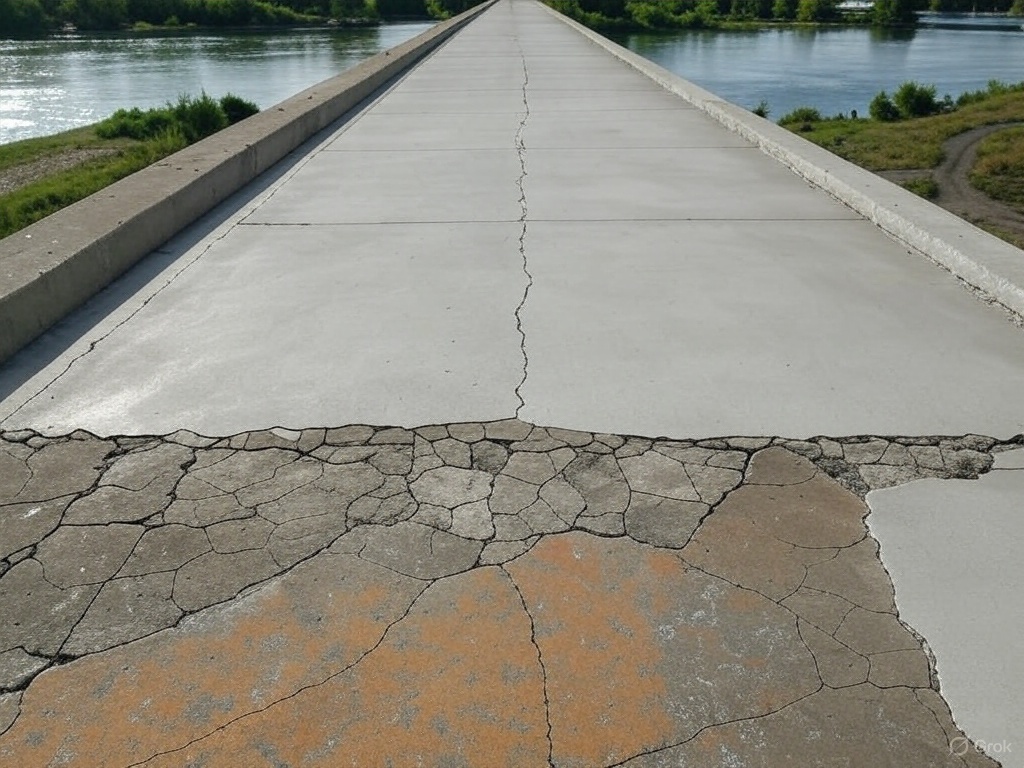
The Concrete Revolution: Self-Healing Concrete That Could Save the World
Imagine a world where crumbling bridges, cracking dams, and collapsing buildings are relics of the past. Enter self-healing concrete, a futuristic material straight out of science fiction that’s now breaking into reality—and it’s poised to revolutionize infrastructure on a dramatic scale. In March 2025, researchers unveiled a breakthrough: a concrete infused with bacteria that “wakes up” when cracks form, secreting limestone to seal itself shut. This isn’t just a patch job—it’s a living, breathing solution to one of humanity’s oldest engineering problems.
The Drama Unfolds
Picture this: a massive highway bridge in a bustling city begins to fracture under the strain of endless traffic. Normally, this would spell disaster—costly repairs, traffic chaos, or even catastrophic collapse. But with self-healing concrete, tiny dormant bacteria (like Bacillus subtilis) spring to life as water seeps into the cracks. Fed by nutrients embedded in the mix, they produce calcium carbonate—nature’s own superglue—mending the damage in days. No cranes, no construction crews, just the silent work of microscopic heroes.
The stakes are sky-high. Aging infrastructure costs the global economy trillions annually—$2.5 trillion in the U.S. alone by some estimates—and concrete failure has claimed countless lives in disasters like the 2021 Surfside condo collapse. Now, this innovation could slash repair budgets, avert tragedies, and even combat climate change by extending the lifespan of carbon-heavy concrete structures.
The Dark Side
But there’s a twist. Critics warn of a dystopian catch: what if these bacteria mutate or escape into the environment? Could we unleash an uncontrollable “concrete plague” that hardens rivers or locks ecosystems in stone? And then there’s the cost—early adopters like the Netherlands have sunk millions into pilot projects (e.g., a self-healing canal in 2024), but scaling it globally could bankrupt smaller nations. The race is on: engineering marvel or ecological nightmare?
Why It Matters Now
On March 29, 2025, a landmark study from Delft University showcased a 50-meter bridge built entirely with self-healing concrete, enduring stress tests that would shatter traditional mixes. Governments and corporations are watching closely—China’s already planning to retrofit its mega-cities, while Elon Musk tweeted, “Self-healing concrete + AI = infrastructure that outlasts us all.” This isn’t just a material; it’s a ticking clock on humanity’s ability to build a resilient future.
Key Points
- Research suggests self-healing concrete can autonomously repair cracks, enhancing durability.
- It seems likely that methods include bacteria, capsules, and natural hydration, with ongoing debates on effectiveness.
- The evidence leans toward benefits like reduced maintenance and environmental sustainability.
- Market growth appears strong, with projections indicating significant expansion by 2033.
What is Self-Healing Concrete?
Self-healing concrete is a type of construction material designed to fix its own cracks without external intervention. It aims to increase the lifespan and durability of structures by sealing cracks that could otherwise lead to further damage.
How Does It Work?
Self-healing concrete operates through two main mechanisms:
- Autogenous Healing: This natural process involves unhydrated cement reacting with water to fill small cracks, effective mainly for microcracks under specific conditions like moisture presence.
- Autonomous Healing: Engineered solutions include embedding bacteria (e.g., Bacillus subtilis), microcapsules with healing agents, or vascular systems that release repair materials when cracks form.
Benefits and Applications
Research suggests benefits include reduced maintenance costs, increased structural durability, and environmental sustainability by minimizing repair needs. It’s being explored for infrastructure like tunnels and marine structures, with companies like Matsuo Construction in Japan promoting it for decarbonization.
Market Trends
The market for self-healing concrete is projected to grow significantly, with estimates suggesting a market size of USD 254.97 billion by 2033, driven by demand for sustainable construction materials

.
Survey Note: Comprehensive Analysis of Self-Healing Concrete
Self-healing concrete represents a transformative advancement in construction materials, offering the potential to autonomously repair cracks and enhance the longevity of structures. This survey note provides a detailed examination of its mechanisms, benefits, recent developments, and market trends, catering to stakeholders in the concrete industry, such as “VolumeConcrete,” who may seek to integrate this technology into their operations.
Definition and Mechanisms
Self-healing concrete is characterized by its ability to fix cracks either autogenously or autonomously, also known as self-repairing concrete. Autogenous healing relies on the natural process of continued hydration of clinker minerals or carbonation of calcium hydroxide, effective primarily for small cracks (10–100 μm, up to 200 μm, less than 300 μm) and requiring water presence. This method is influenced by factors such as concrete age, composition, and crack thickness/form, making it less controllable for larger damages.
Autonomous healing, on the other hand, involves engineered modifications to enhance repair capabilities. These include:
- Microencapsulation: Capsules smaller than 1 mm, containing healing agents like epoxy, release upon crack formation, with a typical ratio of 0.5–1.3 catalyst to microcapsules.
- Macroencapsulation: Utilizes polypropylene or glass fibers with a methyl methacrylate core, diameters ranging from 0.8–5 mm, enabling multiple healing events.
- Vascular Healing: Biomimetic approach using 1D, 2D, or 3D channel networks for continuous healing agent delivery, scalable for applications like bridge decks.
- Self-Healing Bioconcrete: Incorporates microbial activity, such as Bacillus subtilis, to precipitate calcium carbonate, particularly effective in wet-dry environments, with crack width regulation crucial for faster healing.
Recent research, such as a 2024 study on microbial self-healing concrete , highlights challenges like the longevity of microbial spores and cost implications for large-scale applications, indicating ongoing debates on the most effective approach.
Benefits and Practical Applications
The benefits of self-healing concrete are substantial, particularly for reducing maintenance costs and enhancing durability. It prevents the flow of liquids and gases that could corrode reinforcement steel, thus extending the service life of structures. A 2022 review notes its capacity to lower the need for external repairs, limiting reinforcement corrosion and concrete deterioration
.
Practical applications are expanding, with X posts from May 2025 indicating its use in mountain tunnels and marine structures, reducing maintenance costs significantly. For instance, an X post by
@BONTAENGINEER on May 27, 2025, highlighted its adoption for such infrastructure, noting capsule-based self-repair materials activated by water contact

. Companies like Matsuo Construction are promoting it for decarbonization, as seen in X posts from May 26, 2025, by
@SIGMA_Const and
@nkkyushuokinawa, focusing on bacterial-based self-repair to support corporate sustainability goals (X post, X post).
Recent Developments
Recent advancements include bacterial-based methods, with studies from 2022 focusing on Bacillus subtilis in alginate-based materials to improve crack tightness . Polymer-based solutions, such as PNNL’s Self-Healing Cement, combine polymers with cement for rapid 24-hour crack repair, increasing elasticity by 70% and resistance to natural disasters
. Nature-inspired innovations, like Texas A&M University’s lichen-inspired system, were highlighted in X posts from May 21 and 28, 2025, by
@ThomasFrey and
@springwise, respectively, suggesting a living, air-powered repair mechanism (X post, X post).
An August 6, 2024, article from TecScience discussed a groundbreaking self-healing concrete using bacteria and CO2 to seal small cracks, indicating its potential for building walls . Additionally, a October 1, 2024, report from BGR noted its use in the US, repairing cracks without additional concrete, signaling commercial adoption .
Market Trends and Commercial Aspects
The self-healing concrete market is poised for significant growth, with multiple reports projecting high CAGRs. A 2025 report from Straits Research estimates the market to grow from USD 33.87 billion in 2025 to USD 254.97 billion by 2033, at a CAGR of 28.7%

. Grand View Research valued it at USD 24.60 billion in 2019, projecting a CAGR of 37.0% by 2027

. Other projections include Fortune Business Insights forecasting USD 1,038.72 billion by 2032 at a CAGR of 36.8%

, and Precedence Research predicting USD 1376.31 billion by 2034 at a CAGR of 30.33%
.
This growth is driven by increasing infrastructure development, urbanization, and demand for sustainable materials. Europe dominated with a 40% market share in 2024, according to Precedence Research, reflecting regional leadership in adoption. The market’s expansion is also fueled by government-funded consortiums like SARCOS COST Action and SMARTINCS, as noted in a Wikipedia entry from 2021, anticipating revenue from US$34.10 billion in 2021 to US$562.97 billion in 2030

.
Comparative Analysis of Market Projections
To illustrate the variance in market forecasts, the following table summarizes key projections:
| Source | 2024/2025 Value (USD Billion) | End Year | Projected Value (USD Billion) | CAGR (%) |
|---|---|---|---|---|
| Straits Research | 33.87 (2025) | 2033 | 254.97 | 28.7 |
| Grand View Research | 24.60 (2019) | 2027 | – | 37.0 |
| Fortune Business Insights | 84.59 (2024) | 2032 | 1,038.72 | 36.8 |
| Precedence Research | 97.37 (2024) | 2034 | 1,376.31 | 30.33 |
| Data Bridge Market Research | 56.03 (2022) | 2030 | 507.07 | 31.7 |
This table highlights the robust growth expected, with varying base years and end projections reflecting different analytical approaches.
Relevance to Industry Stakeholders
For “VolumeConcrete,” the adoption of self-healing concrete could reduce long-term maintenance costs and align with sustainability goals, given its projected market growth and commercial applications. The technology’s ability to extend structure lifespan, as seen in applications for tunnels and marine structures, could be particularly beneficial for large-scale projects. Engaging with companies like Matsuo Construction or exploring partnerships with research institutions like Texas A&M could provide strategic advantages in this emerging market.
In conclusion, self-healing concrete is not just a technological innovation but a potential game-changer for the construction industry, offering durability, sustainability, and economic benefits. Its ongoing research and commercial adoption, as evidenced by recent X posts and market reports, suggest a promising future, with significant opportunities for industry players to leverage this technology.
Key Citations
- Self-healing concrete Wikipedia overview
- Self-healing concrete fabrication and effectiveness ScienceDirect
- Sustainable future with self-healing concrete RICS
- Self-Healing Concrete Market growth trends Straits Research
- Self-healing Concrete Market size and share Grand View Research
- Self-healing Concrete Market forecast Allied Market Research
- Self-healing concrete market projections Fortune Business Insights
- Self-healing concrete market size Precedence Research
- Microbial self-healing concrete challenges ScienceDirect
- Bacterial self-healing concrete review PMC
- Self-healing concrete PNNL innovation
- Self-healing concrete bacteria and CO2 TecScience
- Self-healing concrete US adoption BGR
- Self-healing concrete review PMC